Showing posts with label Chinese medicine perth. Show all posts

Wednesday, November 16, 2016

Winter flu in spring? Why you get sick in the change of season

Why are flu’s and cold just as common, sometimes more common in spring as they are in winter? 

Why do we get winter colds in warmer weather like spring and summer? 

Chinese medicine has some answers.

As one season ends, another comes. Yin into yang, yang into yin.

While it’s normal around this time of year to rain periodically, its certainly alot colder than it should be for the end of the first month of spring.
The transition between hot and cold seasons is always variable.
The change of season time is when we are the most vulnerable to get sick with cold and flus. One reason could be because lessen our vigilance as the warmer weather approaches. The longer daylight hours, the warmer nights tell us spring is on it’s way and our body can loosen up a bit, which might then open the door to pathogens more easily.
Learn about how Chinese medicine views cold and flu’s in more detail here.
Tips to help lessen your risk of getting sick:
1. Wear a scarf – this will protect your neck from wind and cold invasion.
2. Wear lots of layered clothing. Getting caught out without enough clothes exposes your body to the cold environment. Layers means you won’t be overdressed and get too hot, but you can feel comfortable by not getting unnecessarily too cold either.
3. Have warm clothes ready – Resist the urge to wear lighter clothing just yet, and remember to bring your jacket if your day is likely to turn to evening.
4. Treat symptoms early – herbs and acupuncture are much more effective, and less treatment is needed, when you get to symptoms early on. Marie practices a style of Chinese herbal medicine that has specific formulas for various stages of the common cold and influenza. Even allowing time for rest and recovery instead of “soldiering on” at early stages can often lessen symptoms.
5. Careful when sweating
As spring actually approaches, its the time to do more exercise. Exercise opens our pores, allows sweating so if you’ve already started revving up your exercise and you do come out of the gym on a cold or wet evening (like tonight as I write this email) be extra careful not to expose your hot, wet (sweaty) skin to the environment. Have a shower and change clothes or ensure you have a jacket to protect you as you get to the car. Be careful of running around, getting hot and sweaty in the cold weather.
IMPORTANT NOTICE: This information is provided in public interest of keeping people as healthy as possible. Common sense should always be applied. Too much of anything can be hazardous to health. This information is not intended as a substitute for medical advice or diagnosis by a health practitioner. If you have a health condition, you should check with your health care practitioner before using foods as medicine treatments, if you are in any way unsure about the suitability of the food agents, herbs or recipies for your body. In an medical emergency always contact emergency services, call 000 in Australia.
Chinese medicine organs and some words are capitalised to indicate they are different to the biomedical understanding of the organ. In Chinese medicine each organ represents the system of function according to ancient principals of understanding, including the channel system, spiritual, mental and physical functions. The traditional understanding of Chinese medicine organs is actually a functional system often encompass many now biomedically defined aspects such as lymphatic and endocrine (hormone) functions that are attributed to that organ. A lower case letter of an organ will indicate it’s reference to the biomedical organ. EG Kidney  (the Kidney functions of CM) and kidney (biomedical/physical kidney).
This article is written by Marie Hopkinson, the Chinese Herbalist & Acupuncturist at Metro Health and Medicine in North Perth. Marie is available for consultation by calling 1300 132 830 or email info@metrohealth.com.au or http://www.metrohealth.com.au/new2/make-an-appointment/ 
(C) Marie Hopkinson 2016 Reproduction permissible only with express permission of author.

Sunday, February 7, 2016

How would you rate your health right now?

If you said  “I feel fine”, your probably in the great majority of people. Fine is ok, it’s liveable. Often we don’t know what great or fantastic can be because we settle with fine. Not just our in health, but in lots of areas in life.

When my phone contract ended in October last year, I didn’t get a new iPhone, cause the one I have is fine. It’s doing the job I want it to, despite dropping it numerous times it didn’t get a crack screen, and I did not think it was worth the expense of getting a new one. In marketing they say “fine is the enemy”. If the thing you have already is fine then we, as customers, settle for that. We often don’t see the need for a new one, an upgrade or something different.

Over the years of treating hundreds of people with Chinese Medicine, I often see people come in with all kinds of health problems they describe as “fine”. In the course of the consultation you find out they have aches and pains, digestive and bowel problems, and symptoms that they did not class as a problem or think was bad enough for them to book an appointment for. “Oh I’ve always had this old shoulder pain” or “that chronic back pain (they have had for 5 years)… that’s just a 3/10, I just have to live with that”.

Just because you’ve had constipation for as long as you can remember, doesn’t make it normal!
It’s not that we chose or want these lingering health problems, but if it’s not terrible, sometimes we just live with them, telling ourselves it’s fine.

One of the things I love about my job is seeing the changes that Chinese Medicine can do. I love to see people the week after a treatment, that has dramatically changed their life…when people go from fine to fantastic. Now that doesn’t happen with every patient, but when it does, they are literally jumping for joy.
Sometimes we live with things that are fine, and don’t even realise that we could be fantastic.

When was the last time you discovered something and said to yourself “why didn’t I do this earlier?” I do that in business all the time. When you stumble upon something so fantastic, you couldn’t believe it would change your life so much, and then you think back to how you settled with “fine” before.
If you think your health could be better than fine why not check out my website for my free, self help ideas, and as always, we welcome you to make an appointment where we can work together towards your health goals.


More about Marie, and making an appointment for Chinese Medicine can be found on  the Metro Health website: www.metrohealth.com.au

Friday, November 27, 2015

The difference between acupuncture and acupressure for morning sickness symptoms.


Acupressure for nausea is very common. You can buy acupressure based bands in many travel and airport stores for instance which work on treating the pressure point "Neiguan Pc 6". In my clinic as an acupuncturist over the years i've heard many patients say they tried the bands but didn't feel any real effects. When they have had acupuncture for the same condition it had a much more pronounced effect on the same symptoms so why might this happen? Lets take the example of treating morning sickness for example. 

MORNING SICKNESS
Morning sickness can also lead to tiredness, if the symptoms of dry heaving, nausea and vomiting make it hard to hold down or eat food. Tiredness can come from not bieng able to digest enough foods. Acupuncture and acupuressure is a commonly used treatment for morning sickness. Even if acupuressure does not work to releive the symptoms, there is a big difference between the two therapies.

Acupuncture can access the bodies Qi (Energy) in multiple places at once, while acupressure can only access it in one point at a time (as you press each one). While some treatments of self acupressure can be powerful, there can be many reasons why acupressure dosen't work for morining sickness.
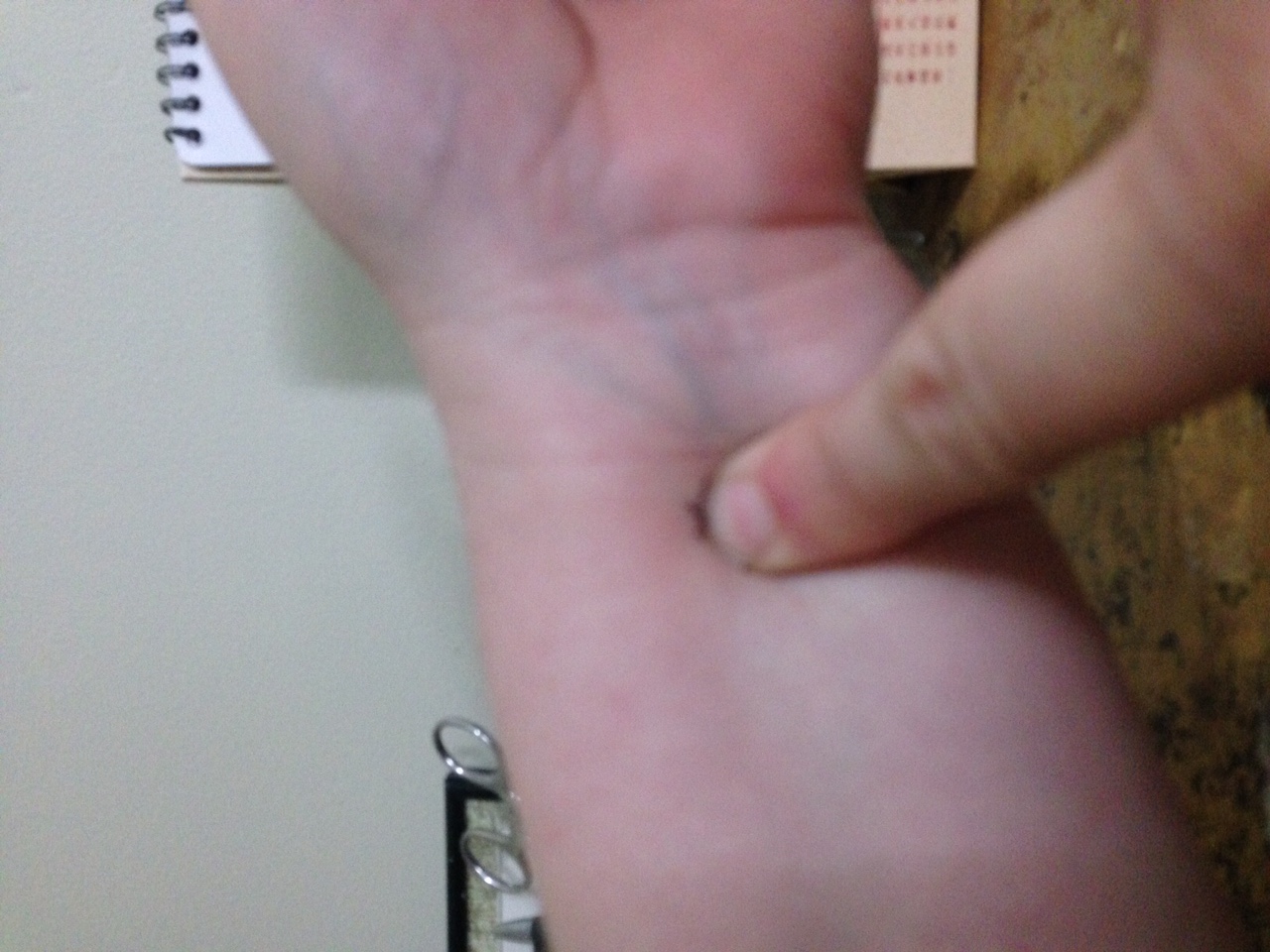
  1. Incorrect point location. One common reason is the point location is wrong. Neiguan Pc 6 (called Pc 6 becuase it's the sixth point on the pericardium channel), is a common point for nausea. it's used in treating travel sickness and you will often see the bands you can put around your wrist to supposedly stop the nausea. If the band is in the wrong place, or the tightness of the band isn't sufficient to press the acupressure point then no effect will likely take place.
Pc 6
Location of Pc 6 Neiguan is deep between 2 tendons
IMG_0070

2. Not enough or correct stimulation of the point. Points are deep in the body not on the skin. Another common reason why acupressure fails some people is that they don't obtain the Qi (Energy) of the acupuncture points by the pressure. An acupressure practitioner (also called a tui na practitioner) is a skilled practitioner of Chinese Medicine (in China it's a 5 year course) and they use around 28 different techniques, all with many hours of repeated, dedicated and specific training to be able to get the Qi (energy) of your body in the acupressure points. Not to say a layperson can't get the Qi, there is just a bit more skill involved than finding a point and pressing on it.
3. Wrong point for the pattern. In Chinese medicine, morning sickness doesn't have a one-size-fit's all diagnosis. When you see an acupuncturist they don't do acupuncture points for morning sickness. they do points for your pattern of disharmony thats causing the morning sickness. Two common patterns are "Liver Energy invading the Stomach" and "Deficiency of energy and blood leading to weakness of the Spleen and Stomach energy"
Essentially with nausea and vomiting, there is a mechanism of action problem with the Stomach Energy. Stomach Qi (Energy) should go down. When Stomach Qi goes up, we call it rebellious Stomach energy. Rebellious Stomach Qi can cause nausea, vomiting, refulx, acidic regurgitation and even epigastric pain. There are other points used for different reasons why the Stomach Qi has become rebellious. Often a combination of points is needed to have a thereaputic effect (as with acupuncture) rather than one point at a time (possible with acupressure).
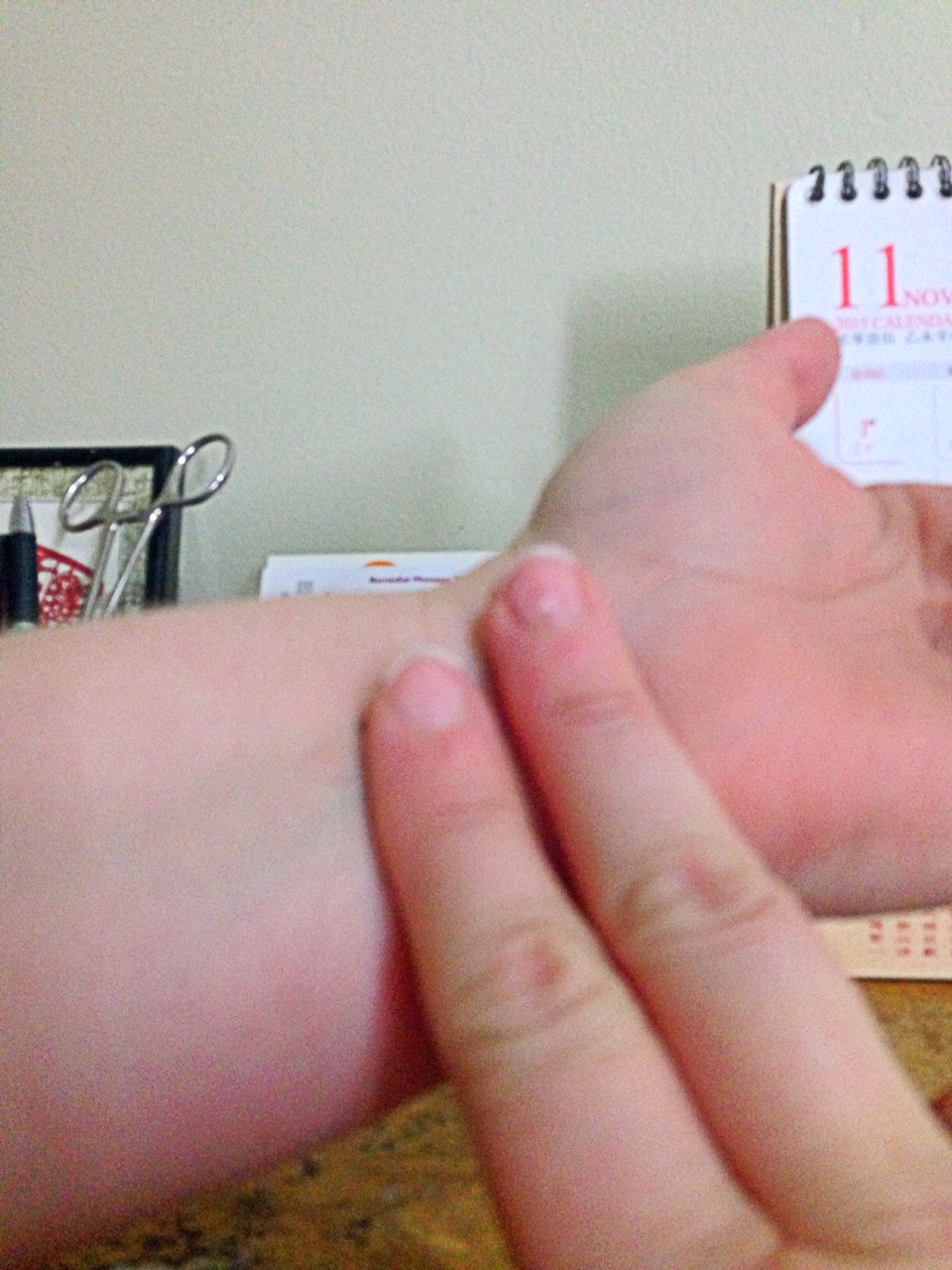
By the way, the location of Pc 6 Neiguan is 2 cun* above the crease of the wrist, on the inside (medial aspect) of the wrist. *a cun is a measurement used in Chinese medicine, based on your body. 2 cun is is two fingers (of your fingers) spaced slightly apart. (1 Cun is the width of a thumb), so Neiguan, PC 6 is:
IMG_0073
The point is that if you've tried acupressure for morning sickness before and it didn't work, it does not mean that acupuncture won't work. Also, that a more targeted or specific approach of acupressure could still be effective. It's worth seeing a professional, qualified practitioner of Chinese Medicine if you are suffering with morning sickness in pregnancy.

ABOUT THE AUTHOR:
Marie Hopkinson is a Chinese Medicine Practitioner, Practicing from her clinic in North Perth, WA- METRO HEALTH AND MEDICINE. Marie can be consulted for appointments, while in-person is preferred, Email /phone consultations can be arranged. Marie has been practicing since 2000, completing initial 3-year course in Chinese Medicine at the Perth Academy of Natural Therapies in WA. Marie has been to China for additional training in the Hangzhou Traditional Chinese Medicine Hospital (Hangzhou Shi Zhong Yi Yuan) twice as well as completing a Master of International Health at Curtin University in 2006. Marie is passionate about the effective practice and understanding of Chinese Medicine and enjoys the opportunity to educate patients about the benefits of self-help aspects such as diet therapy, as well as teaching Chinese Medicine at the Endeavour College of Natural Health.
For more info about booking an appointment with Marie CLICK HERE.
For more info about conditions treated with Acupuncture, and Chinese Herbal Medicine CLICK HERE.